Eduard Bukin
Before running a regression, ask the following four questions (see J. D. Angrist & Pischke, 2009, Ch. 1)
What is the causal relationship of interest?
What is the experiment that could ideally be used to capture the causal effect of interest?
What is your identification strategy?
What is your mode of statistical inference?
Describe an ideal experiment.
Highlight the forces you’d like to manipulate and the factors you’d like to hold constant.
FUQs: fundamentally unidentified questions
Causal effect of race or gender;
Do children that start school 1 year later learn more in the primary school?
Identification strategy
is the manner in which a researcher uses observational data (i.e., data not generated by a randomized trial) to approximate a real experiment (J. D. Angrist & Krueger, 1991)
Use theory!
Analyze, what were/are the policies/environments that could mimic the experimental setting?
describes the population to be studied,
the sample to be used,
and the assumptions made when constructing standard errors.
choose appropriate statistical methods
apply them diligently.
Angrist, J. D., & Krueger, A. B. (1991). Does Compulsory School Attendance Affect Schooling and Earnings? The Quarterly Journal of Economics, 106, 979–1014. https://doi.org/10.2307/2937954
Identification strategy:
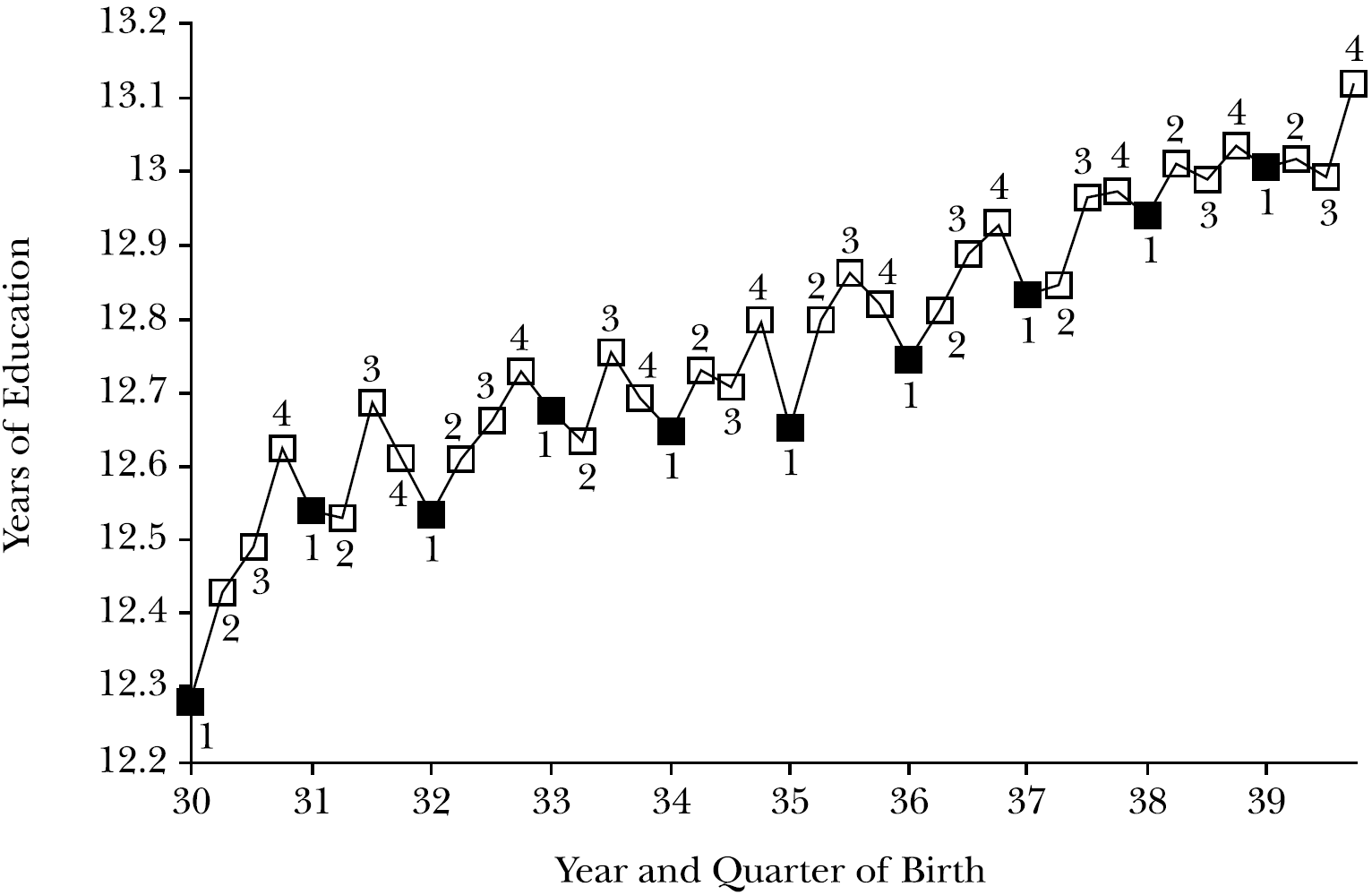
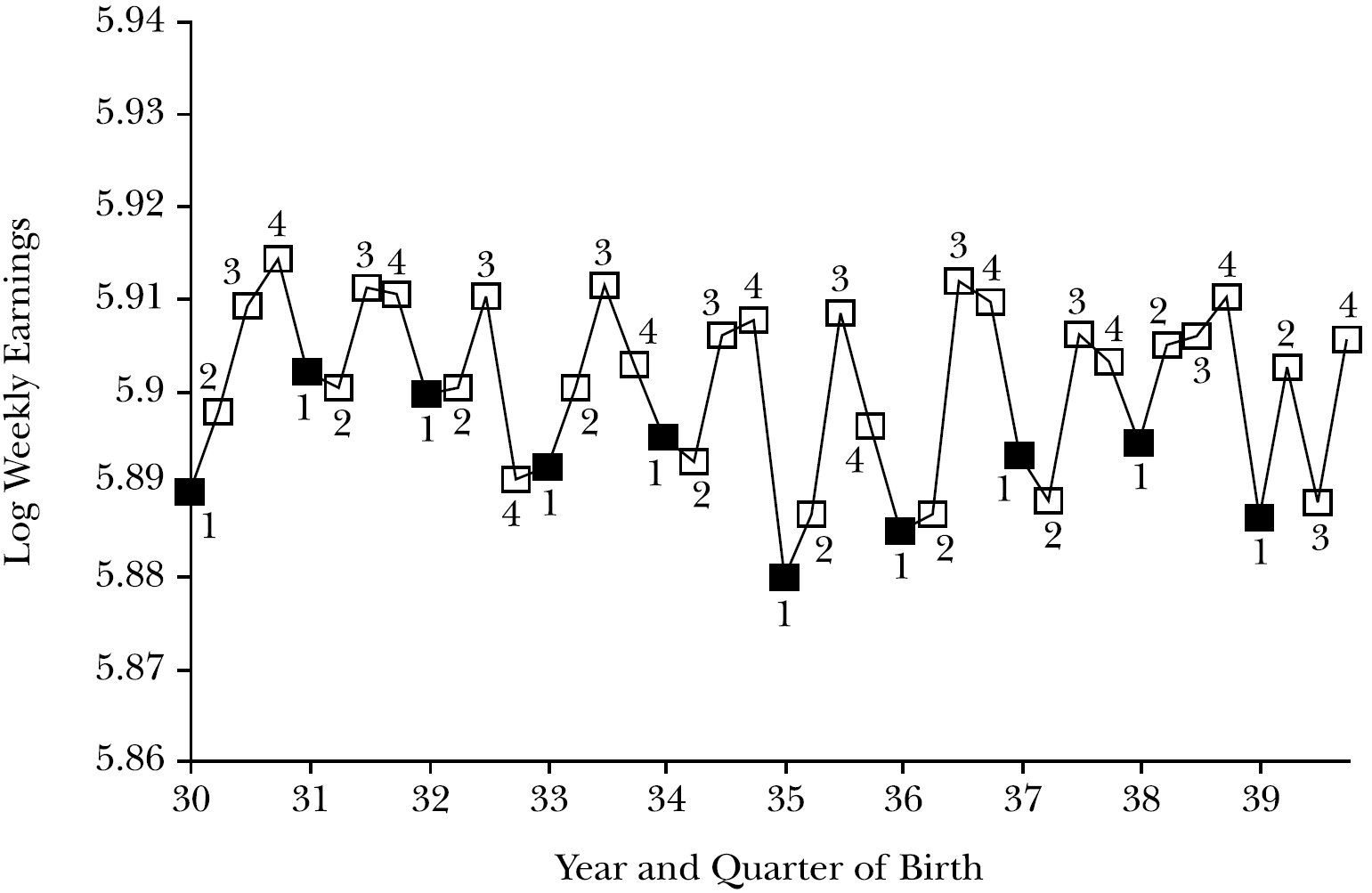
Policy required students to enter school in the calendar year in which they turned six years old;
Children born in the fourth quarter enter school at age 5 and 3⁄4 , while those born in the first quarter enter school at age 6 3⁄4;
Compulsory schooling laws require students to remain in school until their 16th birthdays;
Combination of school start age policies and compulsory schooling laws creates a natural experiment in which children are compelled to attend school for different lengths of time depending on their birthdays.
Source: (J. D. Angrist & Krueger, 1991)
Quarter of birth;
The intuition is:
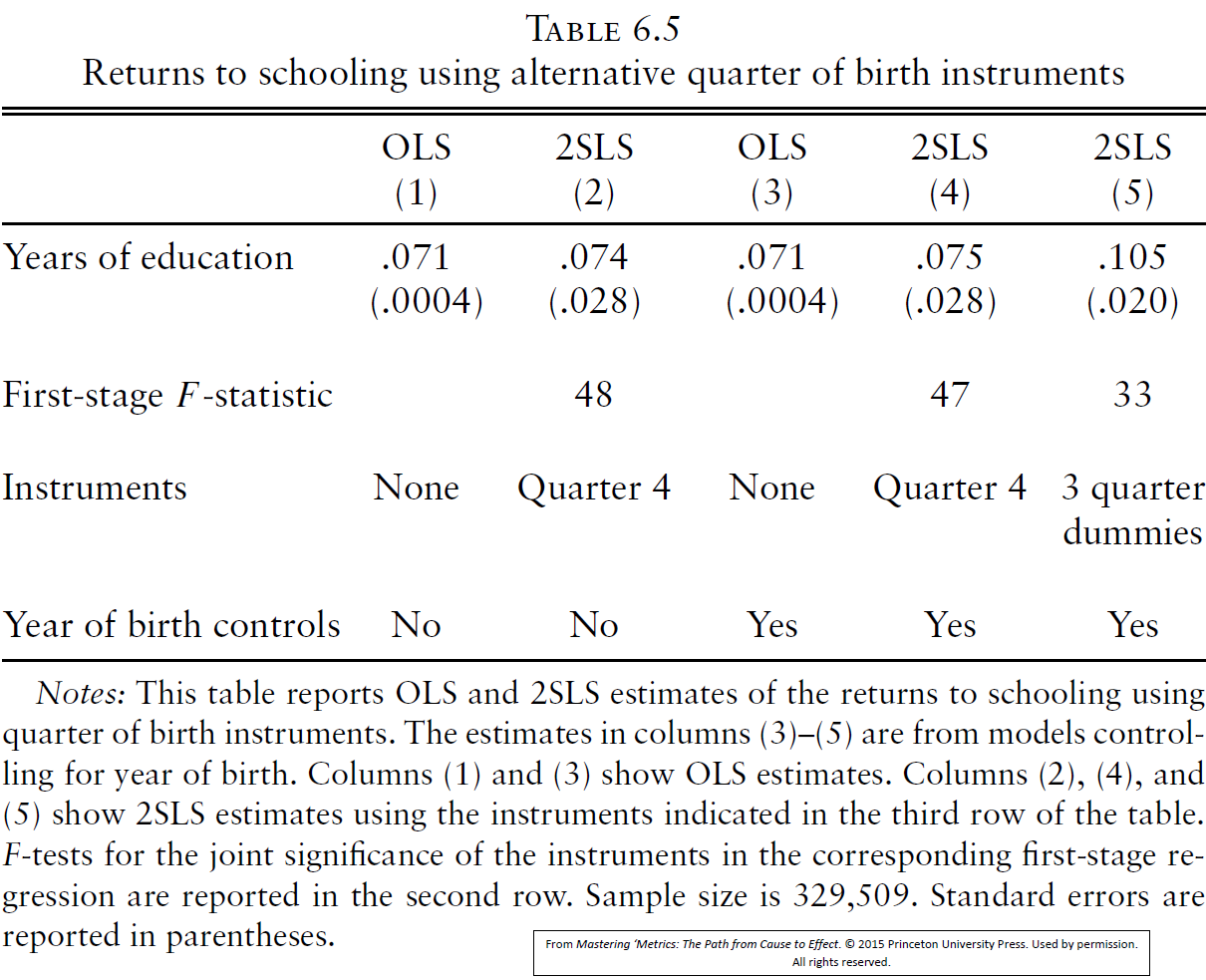
Only a small part of variance in education (the one linked to the quarter of birth) is used to identify the return to education.
This small part of variance occurs due to random natural experiment, thus the ceteris paribus holds here.
IV estimates are very close to the OLS;
What does it mean?
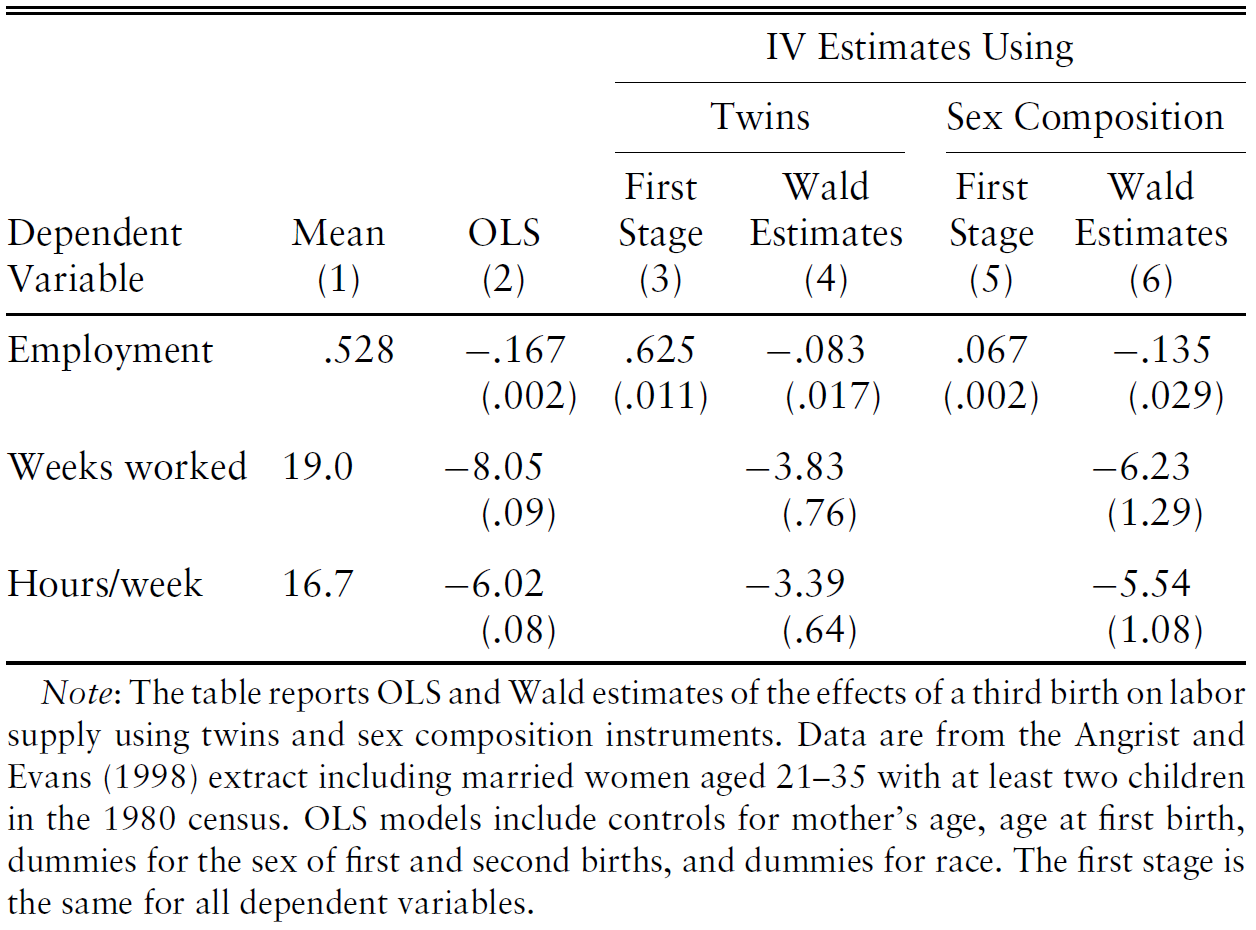
(J. Angrist & Evans, 1998) Angrist, J., & Evans, W. N. (1996). Children and their parents’ labor supply: Evidence from exogenous variation in family size.
What is the effect of additional child on women labor market participation?
Conventional wisdom:
What would the ideal experiment here?
Families without children are inappropriate counter factual
Rich families can afford more children: inappropriate counter factual
Family usually plan for having an additional children
we need a source of exogenous variation in children
People may plan for a second child, but they cannot plan for having twins!!!